
You love your family.
You recognize the sacrifices your parents may have made to build a life in a new country.
You understand how much family, tradition, and belonging can mean.
But sometimes, you also feel caught between the life others imagined for you and the person you’re becoming.
You may want more independence while worrying that your choices will disappoint the people you love.
You may feel grateful for your upbringing while still carrying pain from certain experiences.
And when you try to explain these complicated feelings, you might wonder whether wanting something different means you’re being selfish.
For some adult children of immigrants, navigating family expectations, cultural identity, and personal boundaries can create a unique kind of emotional tension.
These experiences are not universal. Immigrant families differ enormously in their relationships, values, opportunities, and challenges.
But if you recognize parts of your own story here, therapy can offer a place to explore them without having to reject your family or your cultural identity.
Why Can Growing Up Between Cultures Feel Complicated?
Children of immigrants may grow up navigating more than one cultural environment.
At home, certain values, traditions, languages, or family expectations may shape everyday life.
Outside the home, different ideas about relationships, independence, identity, or success may be more prominent.
Many people integrate these influences in meaningful and positive ways.
Being connected to multiple cultures can provide a strong sense of identity, community, and belonging.
But difficulties can arise when expectations feel incompatible.
You might find yourself asking:
- How much independence is acceptable?
- Am I allowed to choose a different career?
- What if my family disagrees with my relationship?
- How can I respect my parents while making my own decisions?
- Why do I feel guilty when I prioritize myself?
The challenge is not necessarily having more than one cultural identity.
It may be feeling that you must choose one part of yourself at the expense of another.
Understanding Guilt in Adult Children of Immigrants
Guilt can sometimes become closely connected to family responsibility.
For example, a parent may have worked long hours, experienced financial uncertainty, or given up opportunities while building a new life.
An adult child may deeply appreciate those sacrifices.
Over time, however, gratitude can become difficult to separate from the belief that personal choices must repay everything their family has done.
That belief can influence decisions about education, career, marriage, finances, and independence.
You might feel guilty about:
- Moving away from family.
- Choosing a career your parents don’t understand.
- Setting limits on your availability.
- Disagreeing with family expectations.
- Spending money or time on yourself.
- Choosing a partner outside certain expectations.
- Declining responsibilities you no longer have the capacity to manage.
Feeling guilty does not automatically mean you’ve done something wrong.
Sometimes guilt reflects a conflict between important values rather than evidence of harm.
Therapy can help you explore that distinction.
When Family Expectations Begin to Affect Your Mental Health
Family expectations are not inherently harmful.
Many families express love through guidance, involvement, shared responsibility, and concern for one another’s future.
However, expectations can become emotionally difficult when someone feels unable to make decisions without fear, shame, or constant pressure.
For example, an adult may feel responsible for maintaining harmony at home, even when doing so requires hiding their own needs.
Another person may work toward career goals that no longer feel meaningful because disappointing their family seems unbearable.
Some people experience anxiety, resentment, emotional exhaustion, or difficulty expressing their preferences.
Others may struggle to identify what they personally want after spending years responding to external expectations.
There is no single explanation for these experiences.
A culturally responsive therapist can help explore both the family context and the individual’s emotional needs without assuming that either family closeness or independence is inherently better.
What Is the Pressure to Make Your Parents’ Sacrifices Worth It?
For some people, a sense of responsibility develops around the opportunities their parents worked to provide.
They may feel compelled to pursue a prestigious career, achieve financial security, or meet particular definitions of success.
Ambition and appreciation can be meaningful sources of motivation.
The difficulty emerges when personal worth begins to depend entirely on meeting expectations.
You may achieve a major goal yet struggle to enjoy it because you’re already worried about the next one.
Or you may avoid exploring interests that feel more authentic because you’re afraid of disappointing your family.
Therapy can offer space to examine whose expectations you’re following and whether they align with your values.
It doesn’t require dismissing your family’s hopes.
Instead, it may help you build a relationship with those hopes that allows room for your own identity.
Why Setting Boundaries Can Feel So Difficult
For some adults, boundaries are associated with rejection, disrespect, or disconnection.
You might worry that saying no will hurt your parents or make you appear ungrateful.
But healthy boundaries do not necessarily mean distancing yourself from your family.
They can involve communicating what you need while remaining considerate of important relationships.
For example, a boundary might sound like:
“I appreciate that you care about my future. I want to make this decision thoughtfully, and I need space to consider what works for me.”
Or:
“I want to spend time with everyone, but I won’t always be available at short notice.”
Or:
“I know we see this differently. I still value our relationship, even if we don’t agree.”
Boundaries are not magic words that guarantee a positive response.
Some families may respond with understanding. Others may need time, and some situations may involve more serious conflict.
A therapist can help you consider your circumstances, safety, and goals before deciding how to communicate or act.
When You Become the Emotional Support Person for Your Family
Some children of immigrants take on responsibilities that are unusually complex for their age.
They may translate important documents, help parents navigate unfamiliar systems, or manage practical responsibilities.
These experiences can also build skills, confidence, and a sense of contribution.
But when a child becomes responsible for adult emotional needs or major decisions, the burden may become overwhelming.
Later in life, that person may struggle to step away from the role of problem-solver or mediator.
They may feel responsible whenever a family member is upset.
They may find it difficult to ask for help because they are accustomed to being the dependable one.
Therapy can help explore these patterns and develop a more balanced understanding of responsibility.
You can care deeply about your family without being responsible for everyone else’s emotions.
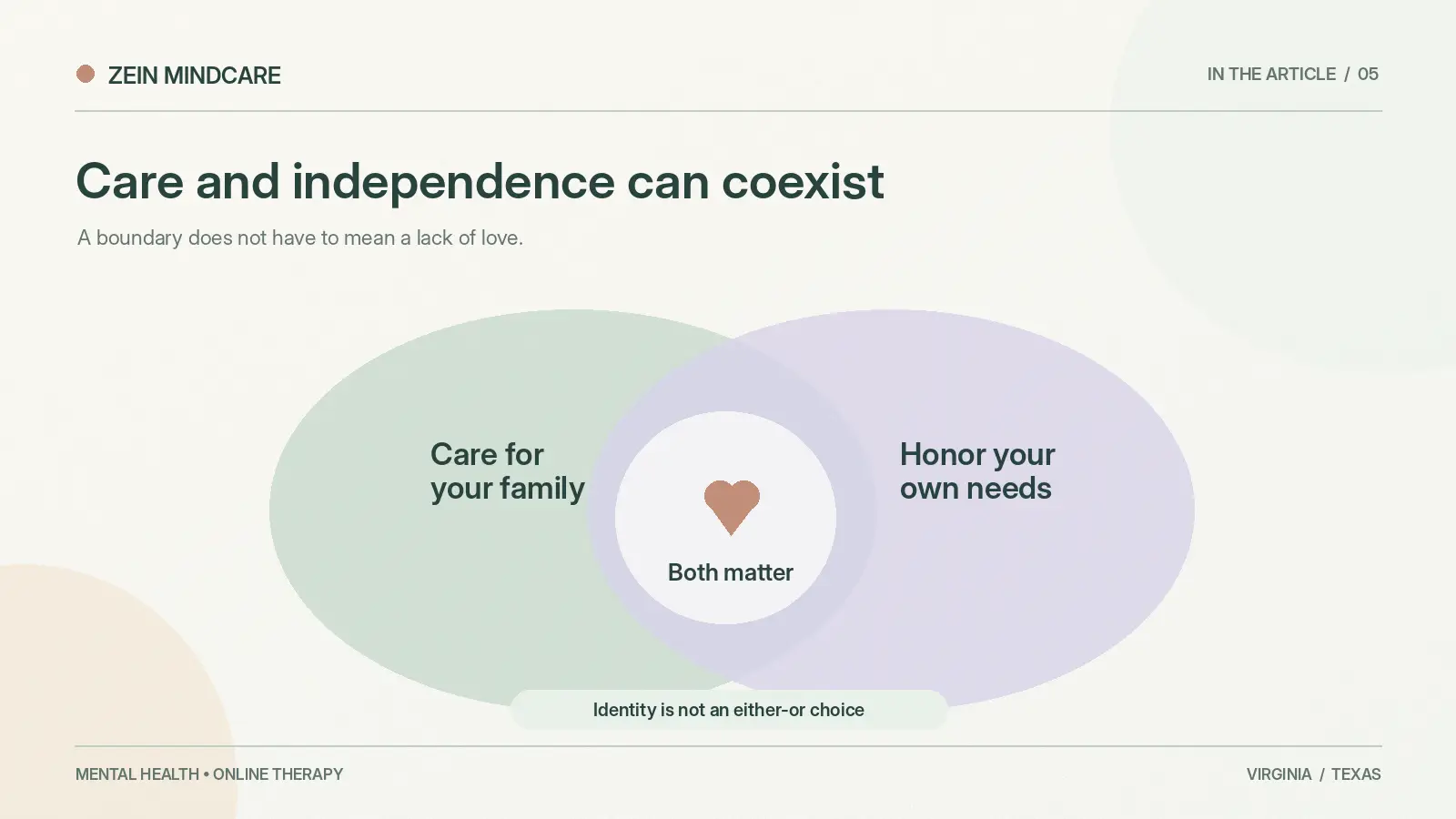
Can You Honor Your Culture and Still Create Your Own Identity?
Yes.
Cultural identity does not have to be an all-or-nothing choice.
You may value family closeness while seeking greater independence.
You may embrace traditions while questioning certain expectations.
You may prefer speaking one language in some settings and another in others.
You may maintain important relationships while making decisions that others would not choose.
Your identity can include many influences, and those influences can evolve throughout your life.
Therapy can support you in exploring what matters most to you without imposing one definition of a healthy or meaningful life.
How Can Culturally Responsive Therapy Help?
Culturally responsive therapy considers how culture, language, family systems, personal identity, and lived experiences shape emotional well-being.
Rather than assuming that everyone experiences family expectations in the same way, the therapist works to understand each individual’s circumstances.
Therapy may help you:
- Explore guilt and conflicting responsibilities.
- Identify values that are meaningful to you.
- Understand anxiety associated with family expectations.
- Recognize recurring relationship patterns.
- Develop communication and boundary-setting skills.
- Process difficult experiences without dismissing positive family connections.
- Build confidence in making personal decisions.
- Find ways to integrate different aspects of cultural identity.
The goal is not to tell you what to believe or encourage you to abandon traditions.
It is to help you understand yourself more clearly and make choices that reflect your circumstances and values.
Why Language Can Matter in Therapy
Sometimes emotions are easier to describe in one language than another.
A phrase spoken by a parent, a family expression, or a cultural expectation may carry meaning that is difficult to capture in translation.
For bilingual individuals, being able to move between languages during therapy can make certain conversations feel more natural.
However, language matching is only one part of therapist fit.
Clinical expertise, trust, collaboration, and the therapist’s willingness to understand your personal experience also matter.
At Zein Mindcare, sessions are available in English and Arabic.
Hunada Zein-Eddin, LPC, emphasizes culturally responsive, trauma-informed care and a collaborative therapeutic relationship.
Learn More About Hunada Zein-Eddin
Therapy for Cultural Identity, Anxiety, and Family Boundaries in Texas and Virginia
You don’t have to wait until family relationships reach a breaking point to seek support.
If cultural expectations, guilt, identity questions, or relationship difficulties are affecting your emotional well-being, therapy may help you explore those experiences.
Zein Mindcare provides virtual individual therapy for eligible residents of Virginia and Texas.
Services include support for anxiety, self-esteem concerns, trauma, life transitions, identity exploration, and relationship difficulties.
Sessions are available in English and Arabic.
You can begin with a complimentary 15-minute consultation to ask questions and discuss whether the practice may be a suitable fit.
Explore Individual Therapy at Zein Mindcare
Frequently Asked Questions
Is it normal to feel guilty about setting boundaries with immigrant parents?
Guilt can arise when personal needs conflict with family expectations or responsibilities. The experience varies by family, but therapy can help you explore what the guilt means and how to respond.
Can therapy help with cultural identity conflicts?
Yes. Therapy may help people explore competing expectations, identify personal values, and navigate complex family and cultural relationships.
Do I need a therapist from my own cultural background?
Not necessarily. Some people prefer a therapist who shares their language or cultural background, while others prioritize different aspects of therapist fit. Cultural responsiveness involves curiosity, respect, and willingness to understand the individual’s experience.
Can I talk about family problems without blaming my parents?
Yes. Therapy can make room for appreciation, compassion, frustration, grief, and other feelings at the same time. Exploring painful experiences does not require reducing family members to simple labels.
Is Arabic-speaking therapy available online?
Zein Mindcare offers online therapy in English and Arabic for eligible clients located in Virginia and Texas.
You Can Value Your Family Without Losing Yourself
You can appreciate the people who shaped your life while still exploring who you want to become.
You can honor your cultural background without feeling that every decision has already been made for you.
And you can seek support for difficult feelings without treating your identity or family relationships as problems that need to be erased.
If you’re navigating family expectations, guilt, anxiety, or identity questions, therapy can provide a place to explore your experiences with care and curiosity.
Zein Mindcare offers culturally responsive online therapy in Virginia and Texas, with sessions in English and Arabic.
Book Your Complimentary 15-Minute Consultation
This article is educational. Family experiences and cultural identities vary widely, and individual mental health concerns should be discussed with a qualified professional.
Further reading